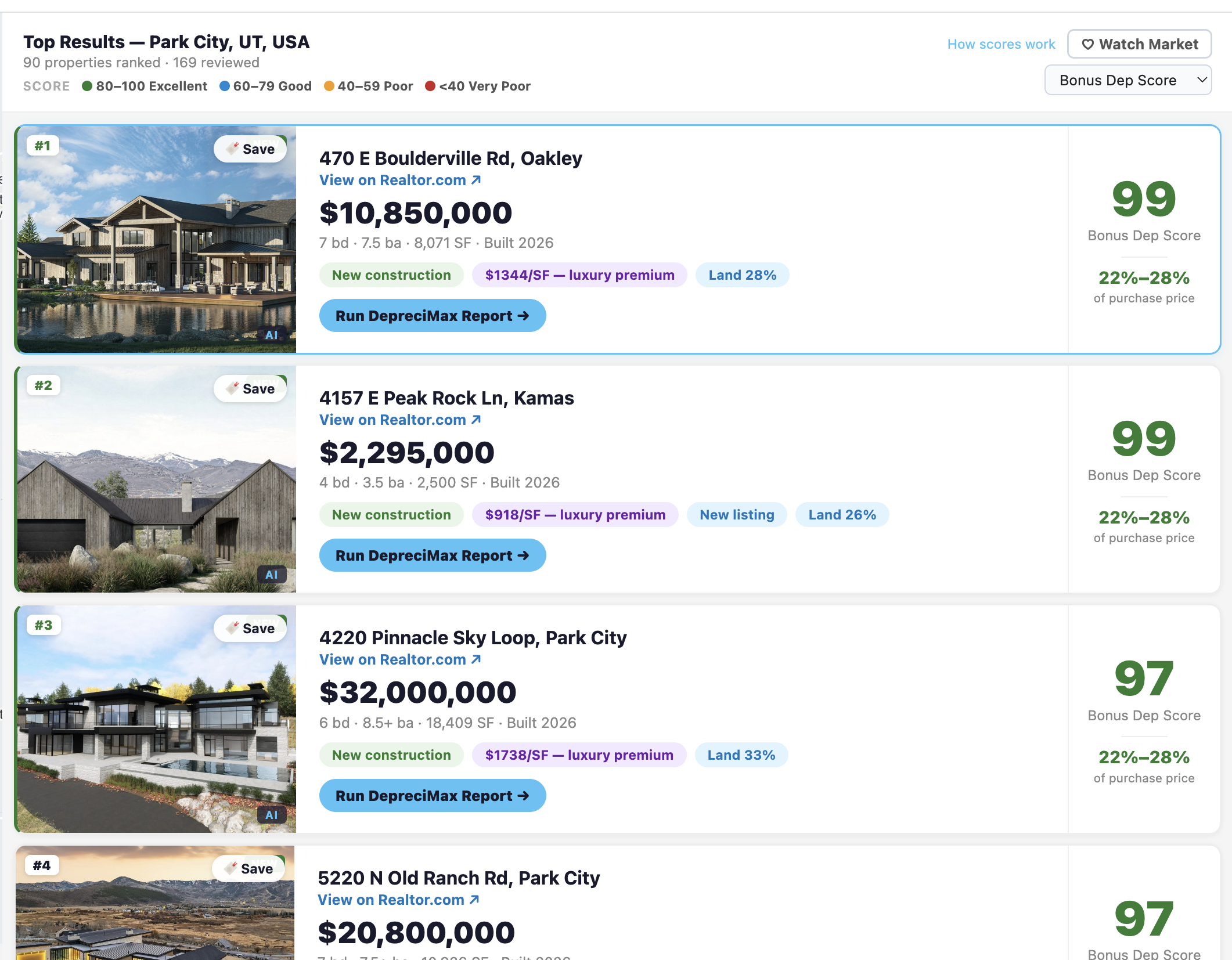
TL;DR — The best ski and mountain STR markets for bonus depreciation in 2026 are Park City UT, Breckenridge CO, South Lake Tahoe CA, Stowe VT, and Steamboat Springs CO. Across the top 10 listings in each (50 properties total), the median Year 1 bonus depreciation deduction was $623,000 — 24.5% of purchase price — on a median $2,487,500 ski home, translating to roughly $230,600 in federal tax savings at a 37% bracket. Park City produced the highest absolute dollar deductions ($1,578,000 median); Breckenridge produced the highest deduction percentage (27.5%) with 100% new construction in its top 10. Each market is broken down in detail below.
For high-W2 earners, pairing bonus depreciation with the short-term rental loophole is one of the few legal paths to offset active wage income with real estate losses — and ski markets generate the largest absolute Year 1 deductions of any STR category.
Ski-town real estate doesn't crush bonus depreciation on percentages — it crushes on absolute dollar deductions. A typical $2.5M Park City or Breckenridge ski home generates $550,000–$700,000 in Year 1 §168(k) deductions, well past the $150k–$220k typical of a top-tier cabin in the Smokies or Blue Ridge. For high-bracket earners with significant W-2 or active business income, the absolute deduction is what matters — and ski markets deliver some of the largest single-property §168(k) deductions available in the short-term rental market.
The trade-off: ski-town land allocations run higher (30–34%) than dedicated cabin markets (12–22%), so the percentage of purchase price you can deduct in Year 1 lands lower. But on a price per square foot basis, ski STRs are often loaded with bonus-eligible build-outs — heated driveways, snow-melt walkways, ski lockers, hot tubs, garages with EV chargers, professional-grade kitchens, and high-end FF&E packages designed for guests paying $1,500–$3,500/night. (For the foundational §168(k) mechanics, see The STR Loophole Explained.)
We pulled the top 10 ski/mountain listings (by DepreciMax bonus depreciation score) from five leading markets on April 28, 2026 — 50 properties total — to ground this in real numbers.
The headline: Across 50 top ski-mountain STR listings analyzed, the median Year 1 bonus depreciation deduction was $623,000 — 24.5% of purchase price. At a 37% federal tax bracket, that translates to ~$230,600 in federal tax savings. The median property cost $2,487,500.
How DepreciMax scored these properties. Every active listing was ranked using land value ratio, year built, price per square foot, property type, and amenity signals from listing copy and photos. The scoring model is calibrated against a known benchmark: a $1,250,000 Ketchum, ID property with a formal Madison SPECS cost segregation study showing 18.9% bonus-eligible — DepreciMax's estimate falls within 4% of that figure. All bonus depreciation calculations assume 100% bonus depreciation under the Tax Relief for American Families and Workers Act of 2025 and the active-activity exception for short-term rentals under Reg. §1.469-1T(e)(3)(ii)(A). Tax savings shown at a 37% federal marginal bracket. Pulled from active for-sale listings April 28, 2026.
The 5 ski-mountain markets at a glance
| Market | Median Price | Land % | Median Y1 $ | Median Y1 % | Tax Savings @ 37% |
|---|---|---|---|---|---|
| Park City, UT | $6,447,500 | 33% | $1,578,000 | 26.8% | $584,000 |
| Breckenridge, CO | $2,800,000 | 32% | $759,000 | 27.5% | $281,000 |
| South Lake Tahoe, CA | $2,374,000 | 30% | $552,000 | 21.7% | $204,000 |
| Stowe, VT | $2,410,000 | 31% | $491,000 | 21.4% | $182,000 |
| Steamboat Springs, CO | $1,000,000 | 34% | $216,000 | 21.8% | $80,000 |
| Top 50 aggregate | $2,487,500 | 31% | $623,000 | 24.5% | $230,600 |
A single ski-mountain purchase in Park City or Breckenridge, when paired with active STR participation and material participation hours, can generate $280,000–$580,000 of W-2 income tax offset in Year 1. For investors deploying $2M+ of capital, that's the kind of leverage that justifies the higher land allocation and active-management requirements of ski markets.
For where Ski markets sit against Lake, Mountain, Beach, Desert, and Urban categories on a percentage basis, our 2026 STR Bonus Depreciation Market Study ranks 197 US STR markets by median bonus-eligible share and breaks the field out by category so you can see the tradeoff directly.
Why ski-mountain STRs deliver such large absolute deductions
The §168(k) calculation is straightforward: total purchase price × (1 − land ratio) × bonus-eligible portion of improvements. Ski markets win on the first variable. A $2,487,500 median price means each percentage point of bonus-eligible deduction is worth $24,875 in deduction dollars — versus $7,150 for a cabin at the $715,000 cabin median. That's a 3.5× multiplier on every percentage point.
Beyond price, ski-mountain STRs typically include amenities that classify under §168(k) as 5-year personal property (finishes, FF&E, professional kitchens, decorative fixtures) and 15-year qualified improvement property and land improvements (heated driveways, hot tubs, decks, ski lockers, outdoor heating). Both categories are 100% bonus-eligible for property placed in service in 2025 and beyond.
A purpose-built ski STR home typically includes:
- Heated driveway and snow-melt walkways (15-year)
- Hot tub on covered deck or rooftop terrace (15-year)
- Ski locker / boot dryer / mudroom storage (5-year personal property)
- Garage with EV charging and ski rack systems (15-year)
- Professional-grade kitchen — Sub-Zero, Wolf, Miele (5-year)
- Custom millwork, beam work, decorative finishes (5-year)
- Furnished with $80k–$150k of FF&E that conveys (5-year)
- Outdoor patios, fire features, landscaped grounds (15-year)
Stack all of that on top of a high-quality wood-frame or timber-frame structural build at $500–$1,700/SF, and the total dollar value of bonus-eligible items typically clears $400,000–$1,500,000 per property — even if the percentage of total purchase price is "only" 22–28%.
What's the number on the property you're looking at?
Upload 7–9 listing photos. Our AI returns a line-item Year 1 deduction estimate closely calibrated to a $5,000–$12,000 cost seg study.
Run a Property Report — $99 →The 5 ski-mountain markets we analyzed
1. Park City, UT — The luxury ski leader
The premier U.S. ski-resort STR market. Easy SLC airport access (35 min), two world-class resorts (Park City Mountain + Deer Valley), and year-round demand from Sundance to summer. The most expensive market we analyzed — and the one that produces the largest absolute Year 1 deductions.
Where to look: Old Town (highest nightly rates, walkable to Park City Mountain base), Empire Pass / Deer Valley (premium ski-in/ski-out), Promontory and Tuhaye (newer luxury developments north of town with bigger lots and more new construction). Park City's STR licensing and zoning vary widely by neighborhood — verify nightly rental allowance before offering.
2. Breckenridge, CO — Highest percentage and 100% new construction
Colorado's highest-volume ski STR market. Two-hour drive from Denver, four resorts inside the Vail Resorts orbit, and a deep new-construction pipeline that drove the highest median Year 1 percentage (27.5%) in our analysis.
Where to look: Peak 7 / Peak 8 base areas (true ski-in/ski-out), Highlands and Shock Hill (premium new builds), Warriors Mark and Carter Park (slightly off-mountain but still under 10-minute shuttle to lifts). Every property in our top 10 was post-2024 new construction — Breckenridge has the deepest current pipeline of purpose-built STR homes among the markets we analyzed.
3. South Lake Tahoe, CA — California ski with the §121 catch
California's largest ski STR market and one of the few with year-round non-ski demand (lake summer, water sports, hiking). High variability in property quality — luxury builds and tear-down inventory side by side.
Where to look: Heavenly Valley side (Stateline / Kingsbury, walkable to gondola), Tahoe Keys (lake access plus ski drive), Al Tahoe / Bijou (older inventory but value entry points). South Lake Tahoe's STR permit cap is binding — verify a permit transfers with the property before offering, or expect a multi-year wait. CA-specific tax considerations also apply; consult a California CPA on §163(j) interest limitations and the state add-back to bonus depreciation.
4. Stowe, VT — East Coast luxury ski, Vermont tax wrinkle
The Northeast's marquee luxury ski destination. Boston, NYC, and Hartford drive markets all within 4 hours. Lower top-end price ceilings than Park City but a tighter property pool — Stowe's inventory is aged, so the new-construction premium is real.
Where to look: Mountain Road corridor (closest to Stowe Mountain Resort), Spruce Peak Resort area (luxury ski-in/ski-out), Edson Hill area (slightly off-mountain but newer luxury inventory). Vermont decouples from federal bonus depreciation — federal §168(k) deduction works for federal tax purposes, but Vermont state taxable income generally requires a state-level addback. Net federal benefit remains; net Vermont state benefit is roughly zero.
5. Steamboat Springs, CO — Lower entry, lower deduction percentage
A value entry point compared to Park City or Breckenridge. Smaller market and older average inventory means lower median deduction percentages — but also a much lower price of entry. The right pick if your investment thesis is rooted in cap rate over total tax shield.
Where to look: Mountain Village area (closest to gondola), Wildhorse Meadows (newer condo and townhome inventory), downtown Steamboat (older single-family with tear-down/rebuild potential). Bonus depreciation math is less compelling at this price point in absolute dollars — but for investors who want a ski STR for under $1M, Steamboat is the cleanest fit among the markets we analyzed.
What separates a top-10 ski STR from a middle-of-pack mountain home
Across all 50 listings analyzed, the highest scoring ski-mountain properties shared a consistent set of traits:
- New construction (2024 and newer). Modern systems, code-compliant heated outdoor systems, current FF&E packages. Older mountain homes often have a much higher 39-year structural share. In Breckenridge, 10 of 10 top-scoring listings were new construction; in Steamboat, only 1 of 10.
- Ski-in/ski-out or sub-quarter-mile lift access. This drives nightly rate premiums of 35–60% and supports higher purchase prices, which compounds the absolute Year 1 deduction.
- Heated outdoor systems and luxury kitchens. Heated driveways, snow-melt walkways, integrated outdoor kitchens, and Sub-Zero / Wolf / Miele appliances are the line items that separate a 95-score property from a 75-score property.
- Furnished sale with conveyed FF&E. Ski markets carry $80k–$150k of FF&E per home — double the cabin market — and that basis only transfers to 5-year property if it conveys.
- Listing copy that signals professional STR operation. Specific mentions of nightly rate ranges, occupancy data, hot tub brands, FF&E packages, and existing rental management partnerships indicate the seller built and operated the property as an STR.
The personal-use trap that kills ski-STR bonus depreciation
The single biggest risk for ski-STR investors: personal use that disqualifies the property as a rental. Under IRS rules, personal use must stay under 14 days per year (or under 10% of rental days, whichever is greater) for the property to qualify as a rental rather than a personal residence under §280A.
Ski homes are particularly vulnerable because owners are tempted to block out peak weeks (Christmas, MLK, President's Day, spring break) for family use — exactly when the property would be earning peak nightly rates. Two consequences if you exceed personal use limits:
- Lost short-term rental classification. If average rental period exceeds 7 days OR if personal use is too high, the property fails the active-activity exception under Reg. §1.469-1T(e)(3)(ii)(A) and reverts to passive-activity status. Bonus depreciation deductions can only offset passive income — they cannot offset W-2 or active business income. For high-bracket earners, this is the entire point of the strategy.
- Section 280A vacation home rules apply. If personal use exceeds 14 days, the property converts to a "vacation home" classification. Deductions are limited to rental income, and excess can't roll forward to offset other income. This is typically catastrophic for the §168(k) Year 1 strategy.
Plan use logs, family stays, and STR operations before closing — not after. If your plan involves blocking December and February for family use, ski-mountain bonus depreciation is probably not your strategy.
What this analysis doesn't capture (and why the report matters)
The numbers above are pre-purchase scoring estimates — useful for narrowing a market and ranking listings, but not engineered to closely calibrated to formal cost seg's bonus-eligible %. Two important caveats:
- The scoring engine is heuristic. It looks at price, square footage, age, listing copy, and amenity signals — not photo content. A property with a stunning custom build and $150k of conveyed FF&E may score similarly to a comparable property without those things.
- Land ratio is a market-level estimate. Real assessor data per-property can differ meaningfully — particularly in ski markets where lots vary from sub-acre in-village to multi-acre estate parcels.
That's what the full $99 DepreciMax property report addresses. You upload 7–9 listing photos, and DepreciMax's algorithm reads every visible finish, fixture, amenity, and FF&E item — classifying each by IRS §168(k) category. Land ratio is sourced from county assessor data per-property. The output is a line-item bonus dep estimate closely calibrated to formal cost segregation studies, in the form of a filing-ready PDF you can hand to your CPA. (For the full pre-purchase workflow, see How to Use IRS §168(k) Before Closing.)
Find a ski-mountain home worth running a report on.
DepreciMax searches any ski or mountain market and ranks every active listing by bonus depreciation potential. Already know the address? Run a Property Report.
Run a Property Report — $99 →Related reading
- Best Cabin STR Markets for Bonus Depreciation in 2026 — sister analysis covering 50 cabin listings in Pigeon Forge, Broken Bow, Blue Ridge, Hocking Hills, and Lake Harmony. Higher percentages, lower absolute deductions.
- Top 10 STR Markets for Bonus Depreciation in 2026 — broader cross-market ranking.
- Cabin vs Condo vs Luxury STR: Which Maximizes Bonus Depreciation? — head-to-head property type comparison.
Frequently asked questions
Are ski and mountain rentals good for bonus depreciation?
Ski and mountain STRs typically produce 21–27% Year 1 bonus depreciation deductions on purchase price — meaningful in absolute dollars because the underlying property values are high. A typical $2.5M Park City or Breckenridge ski home generates $550,000–$700,000 in Year 1 bonus depreciation, translating to $200,000–$260,000 in federal tax savings at a 37% bracket. Hot tubs, heated driveways, ski lockers/gear rooms, garages, and high-end FF&E all classify as 5-year or 15-year property under IRS §168(k).
Which ski market has the highest bonus depreciation potential?
Across our analysis of 50 top ski and mountain STR listings in 5 markets, Breckenridge, CO produced the highest median Year 1 deduction percentage (27.5%) with 10 of 10 top-scoring listings being new construction. Park City, UT produced the highest absolute dollar deductions ($1,578,000 median Y1) due to its premium price points — the median top-10 Park City listing was $6,447,500. For investors prioritizing percentage efficiency, Breckenridge wins; for investors deploying larger capital, Park City delivers the largest dollar deduction.
How much can I deduct on a $2,500,000 ski home in Year 1?
On a $2,500,000 ski home in a top market like Park City or Breckenridge, a typical Year 1 bonus depreciation deduction lands in the $550,000–$700,000 range (22–28% of purchase price). At a 37% federal tax bracket, that translates to approximately $200,000–$260,000 in federal tax savings — assuming the investor materially participates in the STR activity, maintains an average guest stay under 7 days, and the property is genuinely operated as a short-term rental rather than a personal vacation home.
Why do ski markets have lower deduction percentages than cabin markets?
Ski-town real estate carries a higher land allocation — typically 30–34% — versus 12–22% in dedicated cabin markets like Pigeon Forge or Broken Bow. Land is never depreciable under IRS rules, so a higher land ratio reduces the depreciable basis. The trade-off is absolute scale: even at a lower percentage, a $2.5M ski home produces $550k–$700k in Year 1 deductions, which dwarfs the $150k–$220k typical cabin Year 1 deductions in absolute dollars. For high-bracket earners, the absolute deduction matters more than the percentage.
Can I claim bonus depreciation on a ski home I also use personally?
Personal use creates significant problems for ski STR investors. Under IRS rules, personal use must stay under 14 days per year (or under 10% of rental days, whichever is greater) for the property to qualify as a rental rather than a personal residence. Ski homes are particularly vulnerable here because owners are tempted to block out peak weeks for family use. If you exceed personal use limits, the property reclassifies and bonus depreciation deductions can be lost or limited. Maintain rigorous use logs and consult a CPA familiar with §280A before counting on the Year 1 deduction.
Estimates based on top 10 listings (by DepreciMax bonus depreciation score) in each of the 5 markets analyzed, pulled April 2026. Actual results vary by property, jurisdiction, ownership structure, material participation, and tax situation. State-level treatment of bonus depreciation varies — California, Vermont, and several other states require addbacks. This article is for educational purposes only and does not constitute tax or legal advice. Consult a qualified CPA before implementing any tax strategy.