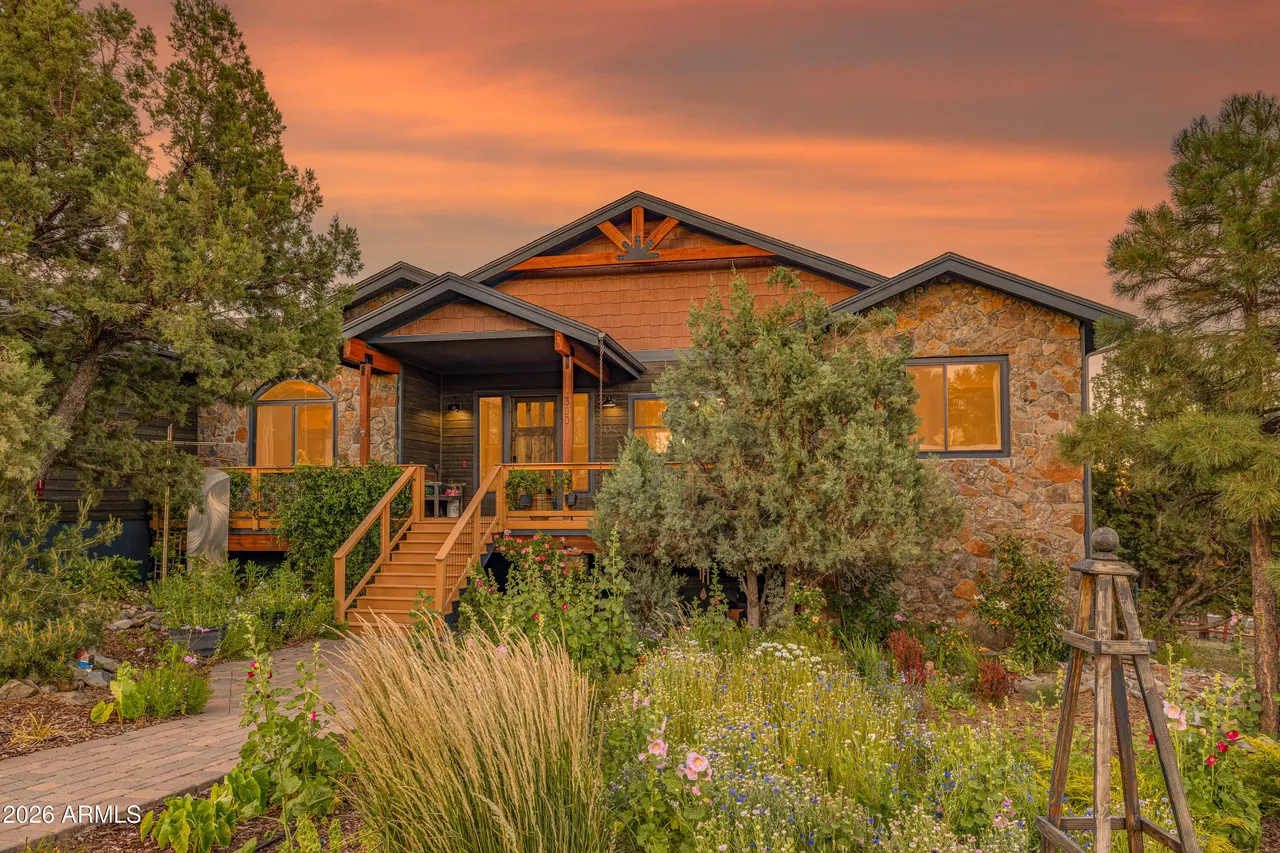
Williams / Grand Canyon, ArizonaSTR Bonus Depreciation Market Profile · #39 in the DepreciMax Top 50
Grand Canyon gateway with unusually low land ratios for a national-park-adjacent market. Arizona full conformity plus high-desert construction economics make Williams a strong dollar-for-dollar play — entry prices well below Sedona and Flagstaff, with equivalent amenity density.
Median across active STR-suitable listings. 1,000+ short-term rentals in market.
Diamond Density
52%
Share of Williams / Grand Canyon STR listings that hit Diamond tier (≥24% bonus-eligible % of purchase price).
Bonus-Eligible %
23.4%
Median % of purchase price classifiable as 5-yr or 15-yr property under §168(k).
Federal Savings @ 37%
$45k
Median federal tax savings on a $515k purchase.
Williams / Grand Canyon at a glance
Rank: #39 of 50 (DepreciMax Top 50 · 2026)
Median Year-1 deduction: ~$121k on a $515k STR
Bonus-eligible %: 23.4% (market median, share of purchase price classifying as 5-year or 15-year property)
Diamond density: 52% of Williams / Grand Canyon STR listings hit ≥24% bonus-eligible % (national Diamond tier)
Gold-or-better density: 74% of listings hit ≥22%
Arizona state §168(k) conformity: Full
Airbnb market depth: 1,000+ active short-term rental listings
Bonus depreciation (IRS §168(k)): a federal tax provision letting investors deduct 100% of qualifying property costs in the year the property is placed in service. For short-term rentals, the deductible portion is the 5-year (personal property) and 15-year (land improvements) components of the total purchase price. See what bonus depreciation is for short-term rentals for the full explainer.
Bonus-eligible %: a DepreciMax metric — the share of a property's purchase price that classifies as 5-year or 15-year property under §168(k), and is therefore 100% deductible in Year 1. Williams / Grand Canyon's market-median bonus-eligible % is 23.4% — meaning a typical $515k Williams / Grand Canyon STR generates ~$121k of Year-1 deduction.
The 7-day STR rule: to unlock the "STR loophole" — where bonus depreciation offsets W-2 and other ordinary income, not just passive rental income — the property must average a guest stay of 7 days or less and the owner must materially participate. See how to qualify for the STR loophole.
Williams regulates STRs under Chapter 117 (Ordinance 995, October 2022) requiring city permit, emergency contact, neighbor notification, insurance, and background checks; state law (ARS 9-500.39) preempts outright bans. Permit: Yes · Cap: — · Min stay: None · Owner-occ.: No. Verified 2026-08-16 against primary jurisdiction sources — read the full regulations profile →
✓
Arizona State Conformity — Full
Arizona fully conforms to federal §168(k). Investors capture the entire Year-1 federal deduction plus Arizona state-level tax savings against Arizona's 2.5% flat rate. The state layer is additive, not subtractive — this is the ideal scenario for bonus depreciation math.
Why Williams / Grand Canyon ranks #39 for STR bonus depreciation
Williams / Grand Canyon ranks #39 because Grand Canyon proximity drives STR demand, Arizona's full §168(k) conformity captures the state benefit at the 2.5% flat rate, and high-desert construction economics keep land ratios low (~22%). Entry prices sit well below Sedona and Flagstaff for comparable amenity density.
What drives Williams / Grand Canyon's bonus depreciation profile?
Williams / Grand Canyon STRs lean on the amenity categories the IRS classifies as 15-year land improvements — hot tub or spa, fire pit / fire feature, outdoor deck or wraparound porch, and outdoor kitchen / bbq area. All 100% bonus-eligible in Year 1 under §168(k). Combined with land ratios that stay in the 19–25% band (leaving 75–81% of purchase price as depreciable basis), that amenity density pushes the market-median bonus-eligible % to 23.4%.
Does Arizona conform to federal §168(k) bonus depreciation?
Investors capture the entire federal-plus-state Year 1 benefit. On a median-priced $515k Williams / Grand Canyon STR, that's ~$45k in federal savings at a 37% bracket plus ~$3k in Arizona state savings at 2.5% flat — combined ~$48k in Year 1. Model with your CPA before committing.
Common bonus-eligible amenities in Williams / Grand Canyon STRs
Prevalence of 15-year land improvements we typically see across Williams / Grand Canyon short-term rentals — all 100% bonus-eligible in Year 1 under IRS §168(k):
Hot tub or spa
66%
Fire pit / fire feature
68%
Outdoor deck or wraparound porch
71%
Outdoor kitchen / BBQ area
39%
Pergola or covered patio
33%
Sauna or bunk room
28%
Williams / Grand Canyon vs Windham vs Palm Springs — bonus depreciation comparison
Williams / Grand Canyon and the two DepreciMax Top 50 markets ranked immediately adjacent by median bonus-eligible %. The comparison is intentionally close-ranked so the deltas that matter — price point, Diamond density, state §168(k) conformity — are directly visible.
Williams / Grand Canyon bonus depreciation calculator (by zip code)
Williams / Grand Canyon spans multiple sub-markets across the Williams corridor with materially different STR economics. The calculator below has a zip dropdown — switch it to your area. The bonus-eligible percentage (Williams / Grand Canyon's market-typical 23.4%) stays constant across zips because it reflects the property type, not the location.
Williams / Grand Canyon zip code comparison
Zip
Sub-market
Land ratio
Typical price
Typical Year-1 deduction
86046
Williams core
Low
$515k
$120k
86001
Flagstaff edge (highest)
Moderate
$649k
$152k
86018
Parks / Bellemont (lowest)
Very low
$355k
$83k
86322
Camp Verde south corridor
Low
$445k
$104k
Sample calculation: $515,000 Williams / Grand Canyon STR (median-priced listing)
Purchase price: $515,000
Williams / Grand Canyon market median: 23.4% of purchase price classifies as bonus-eligible 5-yr + 15-yr property under §168(k)
Year-1 §168(k) deduction: $121k
Federal tax savings at 37% bracket: $45k
See IRS Publication 946 for §168(k) rules. Use the interactive calculator below to model your specific deal.
Looking for a deeper read on your specific property, not just the market median? Run the $99 Williams / Grand Canyon property report — our AI analyzes 7–9 listing photos against the IRS classification rules and returns a line-item §168(k) estimate closely calibrated to a formal $5K–$8K cost seg study.
Representative listings & deductions
Three representative Williams / Grand Canyon listings spanning entry, mid, and high price tiers. Year 1 deduction is estimated as a range around the Williams / Grand Canyon market bonus-eligible average (23.4% ± 3 percentage points). Click any card to run a full property report to tighten to one exact number.
How to use this data to underwrite a Williams / Grand Canyon STR deal
The market-median numbers on this page are a screening tool, not a final answer. Here's how STR investors and their CPAs actually convert a market rank + median bonus-eligible % into an underwriting number for a specific offer.
Screen the deal against the market median. If a Williams / Grand Canyon listing is priced within the p25–p75 range ($355k–$650k) and looks like a typical nationalpark STR, the market-median 23.4% bonus-eligible is a defensible screening estimate. That gives you a Year-1 deduction range you can plug into an initial underwriting model in about 60 seconds — before you invest CPA time or offer-drafting effort.
Adjust up or down based on amenity signals. Williams / Grand Canyon properties with a full outdoor stack trend toward the Diamond tier at 24%+ bonus-eligible. Properties with minimal outdoor amenities — condos, plain subdivision homes without hot tubs / decks / fire pits — trend toward the Bronze tier at 18–20%. Use the amenity checklist to categorize before you commit.
Model the offer with the deduction baked in. Take the estimated Year-1 deduction × your federal marginal rate (typically 37% for high-earner STR investors) = federal tax savings. Add this to your effective Year-1 cash-on-cash return. On a $515k Williams / Grand Canyon STR at 23.4% bonus-eligible, that's ~$45k in federal savings plus ~$3k in Arizona state savings at 2.5% flat.
Verify with a $99 property-level report before you sign. Once you're past screening and preparing to make an offer, run the specific property through DepreciMax's photo-analysis pipeline. The $99 report tightens the estimate to a single number, line-items the 5-year / 15-year / 39-year breakdown, and delivers a calibrated Year-1 number closely calibrated to a formal cost segregation study's bonus-eligible %. Your CPA can build the return directly from this output; a formal engineered study (typically $5,000–$8,000) is only necessary post-closing for IRS-defensible filing on very large deductions or high-scrutiny audit risk.
Verified as of 2026-08-16 against primary jurisdiction sources. See the full Williams STR regulations page for jurisdiction breakdown, ordinance section numbers, and 5-question FAQ.
Verified as of 2026-08-16 against primary jurisdiction sources. See the full Williams STR regulations page for jurisdiction breakdown, ordinance section numbers, and 5-question FAQ.
Williams / Grand Canyon's #39 rank comes from the DepreciMax Top 50 methodology: we score every active STR-suitable listing across the nation's most-watched STR markets on land value, state §168(k) conformity, and amenity mix, then rank markets by the median bonus-eligible % of their active listings. Individual property estimates are closely calibrated to a formal cost segregation study.
Sample listings are representative of active Williams / Grand Canyon inventory — addresses shown are typical for each price tier. Bonus depreciation outcomes vary by individual property; this page estimates ranges for typical purchases. Not tax advice — consult your CPA before making investment decisions.
Score live Williams / Grand Canyon properties — for your specific deal
Run any active Williams / Grand Canyon listing through the DepreciMax property scorer. Free market search shows you every listing ranked by bonus depreciation potential. $99 per detailed AI report on a specific property — closely calibrated to a formal cost seg study.